2025 Session
|
Thursday, October 29, 2026
Is the UK ready for AI?
Artificial Intelligence
|
11:20 am
-
12:00 pm
%20(1).png)
The UK wants to become an AI superpower, but ambition alone will not deliver it. This session tests the country’s readiness across government, infrastructure, regulation, transport, skills and public trust. Leaders shaping national policy and deploying frontier technologies will explore where Britain is moving quickly, where it risks falling behind and what readiness really requires.

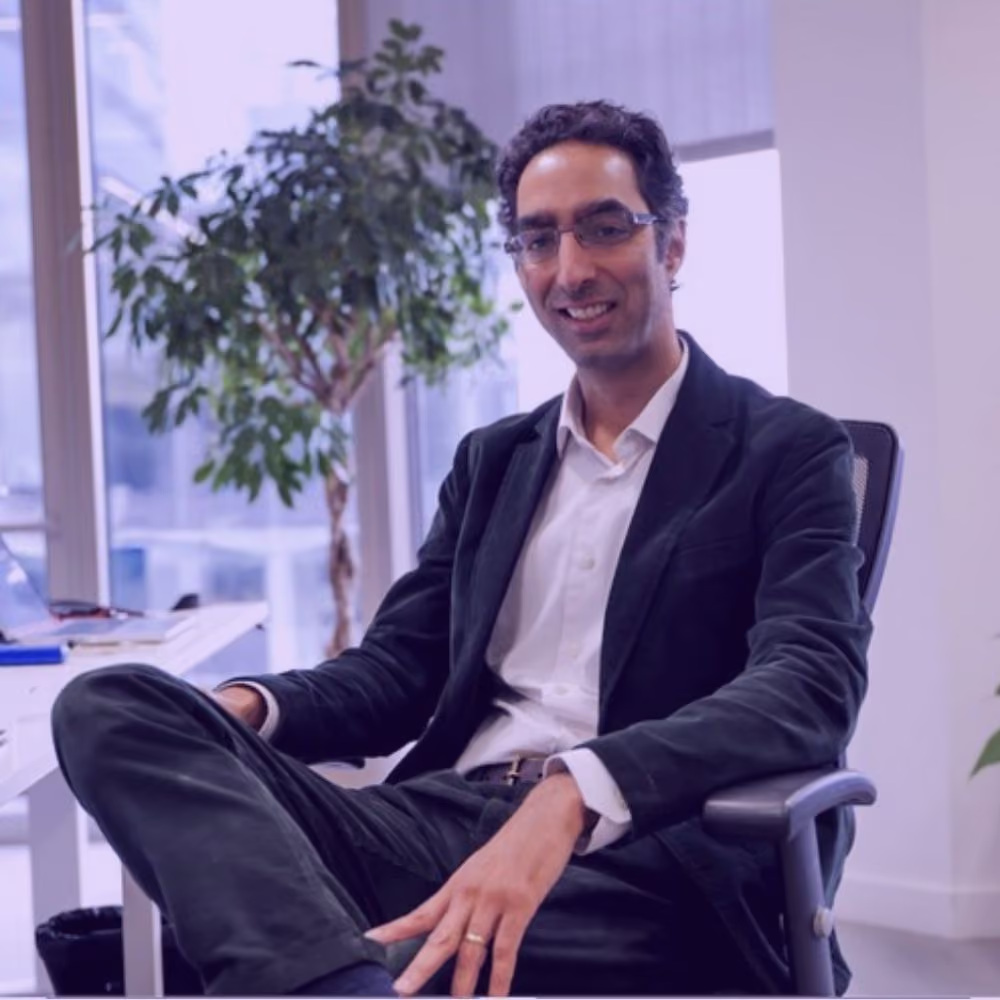
Kalbir Sohi is the UK Government Chief Artificial Intelligence Officer (CAIO) at the Government Digital Service (GDS), part of the Department for Digital, Culture, Media and Sport (DCMS). In this role, he oversees the AI teams within GDS, leading dedicated units focused on identifying, testing and scaling artificial intelligence solutions across government to improve public services, increase productivity and deliver better outcomes for citizens. This work supports the ambitions set out in the Blueprint for Modern Digital Government.Before joining GDS, Kalbir served as Product Director for Core Infrastructure at Spotify, where he led teams responsible for building and scaling the foundational engineering platforms underpinning Spotify's global services. His career spans both the public and private sectors, including senior roles at Facebook, Weaveworks and HM Revenue & Customs, as well as experience as a startup founder and CEO. Combining public service, entrepreneurship and deep technical leadership, Kalbir brings extensive expertise in cloud infrastructure, artificial intelligence and machine learning, data governance and product strategy, with a strong focus on the responsible adoption of emerging technologies.

Florian leads Samsara's public policy and government affairs work in Europe, with a particular focus on the UK. A German national, he has spent the last 15 years inhouse at various technology companies, working on issues such as autonomous vehicles, micromobility, robotics, logistics, privacy, and artificial intelligence. His work has led to a number of first-of-its-kind legislative and regulatory frameworks on new and nascent technologies in multiple national European jurisdictions as well as Brussels. He has also been embedded at the highest levels of government and politics through his roles within a major German political party.

Nathan Ashley is a Public Policy Manager at Waymo supporting the company in its preparations to bring its autonomous driving technology to London. Nathan has more than a decade of experience in public affairs, strategic communications, and policy, advising organisations across transport, technology, energy, food, music, and sport. Before joining Waymo, he led the public affairs practice at DRD Partnership, developed Voi Technology's safety, sustainability, and equity policy programme across more than 11 countries, and was an Adviser to the current Mayor of London, Sir Sadiq Khan. Nathan is also a trustee of the Chineke! Orchestra and a former SDG Ambassador.

Behind every percentage point is a person. Yvette Schmitter has built her career making sure no one in the room forgets it. Most AI security guards the doors while the real risk walks in wearing the model's own credentials. She built Fusion Collective to watch what a system does after it passes every check. She's CEO and co-founder of the independent AI governance, audit, and assurance firm, built on one principle: the auditor cannot be the vendor. As AI takes on decisions that shape people's lives, she's the independent check that proves a system is safe and worthy of trust, catching it the moment it drifts. Her work has led to the protection of than 2+ million people. Fusion Collective and Fusion Sentinel were shortlisted at the 2026 A.I. Awards for Most Innovative AI Technology, Best Consideration of Ethics and Governance in AI, and AI for Good. An ISO 42001 Lead Auditor, she directed one of the largest cloud migrations in AWS history and advises the not-for-profits shaping AI regulation with the US Congress and UK Parliament. She returns to Black Tech Fest to moderate roundtables and panels on cybersecurity, ethical AI, and trust, because the future of AI should belong to all of us, and the people it forgets are the ones she puts back in the room.


